The Inner Gold Approach™

A whole-person way of working with emotional and physical health
I work as a psychotherapist and a Board-Certified Health & Wellness Coach (NBC-HWC). That means I work with both emotional life and physical wellbeing, and I don’t treat them as separate.
Many people come to me having already done a lot of work. They’ve read the books, tried protocols, understood their patterns, and pushed themselves to improve. What’s often missing isn’t effort or insight, but the capacity to stay present with themselves when things are uncomfortable, painful, or uncertain.
This work is about developing that capacity. When you can stay with what you’re feeling and experiencing without overriding it or forcing change, something begins to reorganise on its own. Acceptance is not resignation. It’s the point where real movement becomes possible.
How I work
I work in an integrative way, guided by what’s actually happening for you rather than a fixed method or formula. My role is to track the emotional, physical, and relational layers of your experience at the same time, and to guide the work so it supports real change rather than more effort.
Some sessions are primarily conversational and reflective. Others involve body-based awareness, working directly with sensations, impulses, and nervous system responses. At times the work is emotional and relational; at other times it focuses on patterns in health, energy, or daily life that are affecting your wellbeing.
Depending on what’s most relevant, our work may include deep listening and talk therapy, somatic approaches that support safety and felt-sense awareness, inner child and parts-based work, or symbolic processes such as Sandplay (available in person). I also draw on transpersonal perspectives, particularly when questions of meaning, identity, or spiritual experience are part of what’s emerging.
To work with the physical side, I also offer health and wellness coaching. This may involve more structured support around areas such as food, energy, routines, or recovery. These are not separate tracks. They are different ways of working with the same system, used when they’re helpful rather than because they belong to a program.
I’m also supportive of 12-step and recovery-based work and often work alongside it.
These aren’t techniques that get “applied.” They’re different ways of listening and responding, depending on what’s present. If you’d like a sense of the formal training and models that inform how I work, you can explore that on my Qualifications page.
The Inner Gold Wheel
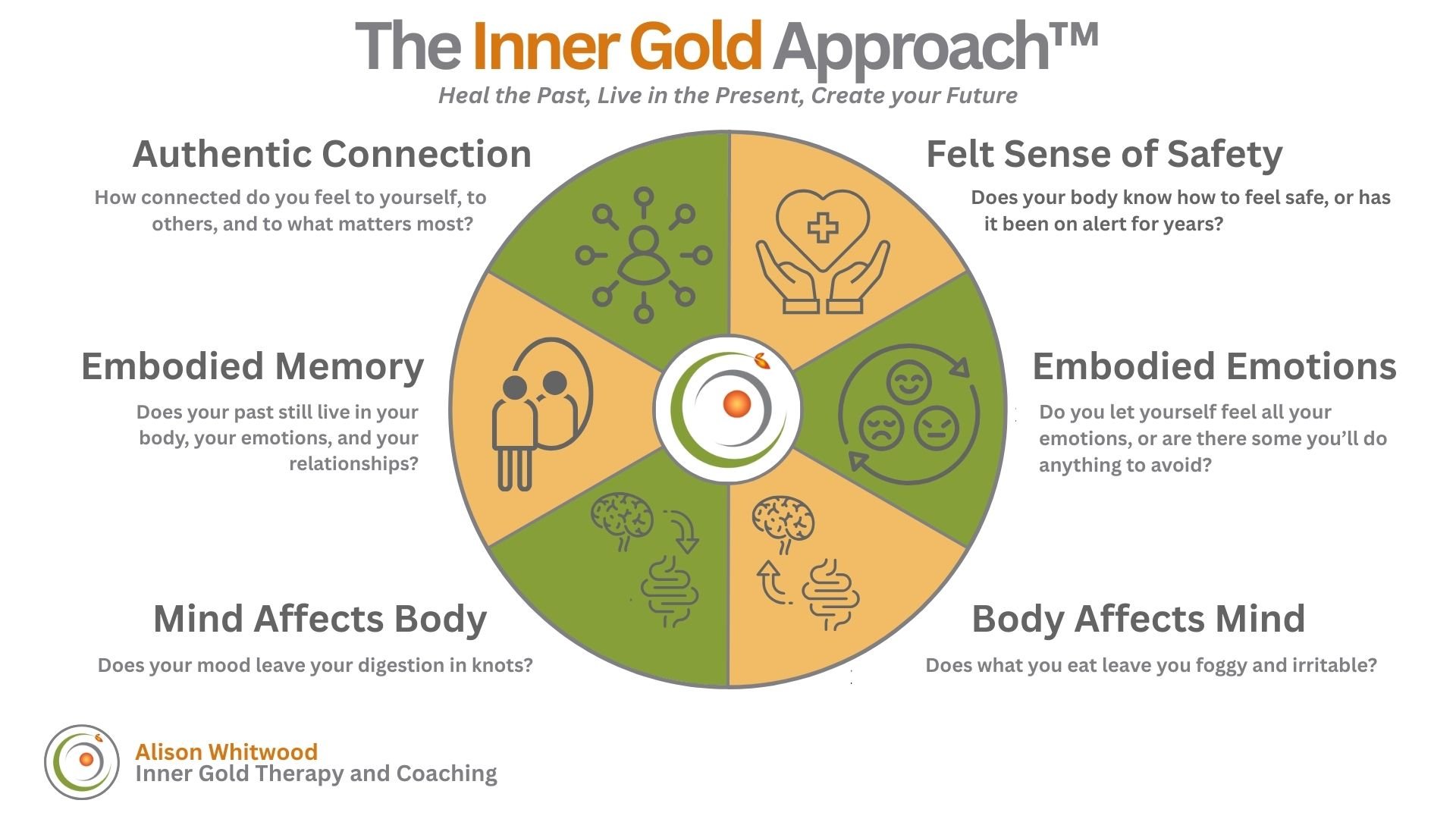
Over time, I’ve noticed that the work we do tends to touch a few key areas again and again. I sometimes use the Inner Gold Wheel as a way of holding the bigger picture — not as a checklist or a process to move through, but as a map of how emotional, physical, and relational health interact.
We don’t work through these areas in order. We follow what’s most alive and relevant. The Wheel simply helps me keep sight of the whole system while we focus on what matters most for you.
What happens in a session
Sessions aren’t short check-ins or problem-solving conversations. They’re designed to give enough time for things to actually shift.
We begin by orienting to where you are — not just what you want to talk about, but how your system is arriving in the room. From there, I guide the session based on what’s most relevant, whether that’s conversation, body-based awareness, symbolic work, or practical exploration of how your physical health and emotional life are interacting.
I’m actively tracking pace and depth. Sometimes that means slowing things down so something can be properly felt and integrated. At other times it means being more direct, naming patterns or choices that are asking for attention. The work is responsive, but it isn’t unstructured.
This isn’t the kind of work that’s meant to be “done” in a single session. Change tends to unfold over time, through repeated experiences of being met, understood, and guided rather than pushed. Continuity matters, because it allows insights and shifts to settle and integrate.
How physical health fits into this work
I don’t treat physical health as a separate project or a set of behaviours to get right.
Food, inflammation, exhaustion, weight changes, and symptoms often carry emotional and nervous system information. Addressing them without understanding that context can lead to more pressure and self-blame.
Where appropriate, I support approaches such as the Autoimmune Protocol (AIP), but always in a way that takes the whole person into account, including emotional load, stress, history, and capacity.
Who this approach tends to suit
This way of working often suits people who know they can’t think or push their way into healing anymore.
It may not be the right fit if you’re looking for rigid protocols, quick fixes, or someone to tell you exactly what to do without engaging the deeper picture.
Next steps
If you’d like to understand the practical details of working together, you can visit the Work With Me page. You’re also welcome to explore my Qualifications, FAQs, or Blog to get a fuller sense of how I think and work.